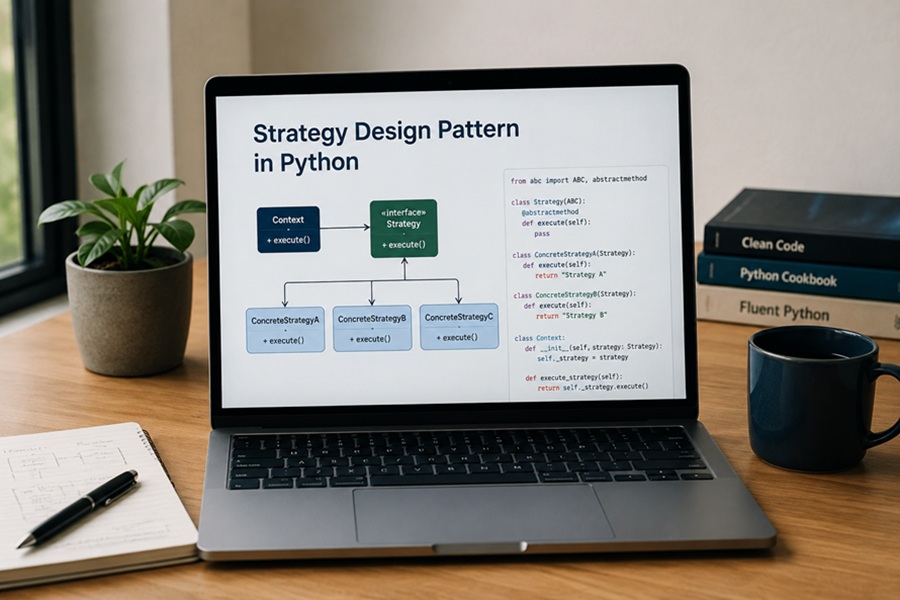
DISCLAIMER: Image is generated using ChatGPT.
My formal introduction to Python was about two years ago when I took some courses by LinkedIn Learnings. Since I don’t use Python on a daily basis, I tend to forget things. Luckliy, participating in The Weekly Challenge helps me keep my skills sharp.
A few days ago, I published a blog post about Strategy Design Pattern in Perl, and I received a lot of positive feedback. Last night, I started thinking: why not re-create the same concept in Python? As I was preparing for that post, an idea popped into my head: why not expand the project to cover design patterns in their entirety?
Hang on, what if I rewrote, Design Patterns in Modern Perl for Python.
It’s a good idea, but there is one challenge: I am already working on my second book which focuses on DBIx::Class and is about 60%-70% finished. I can’t start another project until that one is complete.
That said, I assume there would be a demand for a book that explores these patterns using Modern Python.
The premise would remain the same as the original Perl book, but it would leverage all the latest Python features.
I am presenting a "flavour" of that makeover in this blog post using my original Perl post as the foundation.
The Strategy design pattern is a behavioural design pattern that allows behaviour to be selected dynamically at runtime.
The main objective is to create concrete class for each behaviour.
Traditionally, in OOP, you define an interface and implement concrete class for each strategy.
In Python, normally you use abc module to define an Abstract Base Class.
But why creating abstract class?
Don’t we need an interface?
Let’s get the basic define first.
Interface:A completely empty contract. It contains only method signatures but no data (state) and no implementation code. A class implements an interface.
Abstract Class:A partially written class. It can have method signatures, but it can also have concrete methods and member variables. It cannot be instantiated on its own. A class extends (inherits from) an abstract class.
Python does not have a built-in interface keyword. Instead, Python uses the abc module to do dual roles for both concepts.
For example:
Interface
from abc import ABC, abstractmethod

class FormatterStrategy(ABC):
    @abstractmethod
    def format(self, text: str) -> str:
        pass
Abstract Class
from abc import ABC, abstractmethod

class FormatterStrategy(ABC):
    def strip(self, text: str) -> str:
        return text.strip()

    @abstractmethod
    def format(self, text: str) -> str:
        pass
Here is the same example from the post in Perl, re-written in Python.
class TextFormatter:
    def __init__(self, strategy: str):
        self.strategy = strategy

    def publish(self, text: str) -> str:
        if self.strategy.lower() == "upper":
            return text.upper()
        elif self.strategy.lower() == "lower":
            return text.lower()
        return text

if __name__ == "__main__":
    upper_case = TextFormatter(strategy="upper")
    lower_case = TextFormatter(strategy="lower")

    text = "IpHonE"
    assert upper_case.publish(text) == "IPHONE"
    assert lower_case.publish(text) == "iphone"
    print("Initial tests passed successfully!")
Same issue, if we want to add another strategy then we would violate Open/Closed Principle (OCP), one of the five SOLID core design principles.
Like below:
class TextFormatter:
    def __init__(self, strategy: str):
        self.strategy = strategy

    def publish(self, text: str) -> str:
        if self.strategy.lower() == "upper":
            return text.upper()
        elif self.strategy.lower() == "lower":
            return text.lower()
        elif self.strategy.lower() == "camel":
            if len(text) >= 2:
                return text[0].lower() + text[1].upper() + text[2:].lower()
            return text
        return text

if __name__ == "__main__":
    upper_case = TextFormatter(strategy="upper")
    lower_case = TextFormatter(strategy="lower")
    camel_case = TextFormatter(strategy="camel")

    text = "IpHonE"
    assert upper_case.publish(text) == "IPHONE"
    assert lower_case.publish(text) == "iphone"
    assert camel_case.publish(text) == "iPhone"
    print("Extended conditional tests passed successfully!")
To avoid that we can implement the Strategy design pattern. For this we would create an interface and three concrete classes using abc module. Also one context class as below:
from abc import ABC, abstractmethod

class FormatterStrategy(ABC):
    @abstractmethod
    def format(self, text: str) -> str:
        pass

class UpperCaseFormatter(FormatterStrategy):
    def format(self, text: str) -> str:
        return text.upper()

class LowerCaseFormatter(FormatterStrategy):
    def format(self, text: str) -> str:
        return text.lower()

class CamelCaseFormatter(FormatterStrategy):
    def format(self, text: str) -> str:
        return text[0].lower() + text[1].upper() + text[2:].lower()

class TextFormatter:
    def __init__(self, strategy: FormatterStrategy):
        self.strategy = strategy

    def publish(self, text: str) -> str:
        return self.strategy.format(text)

if __name__ == "__main__":
    upper_case = TextFormatter(strategy=UpperCaseFormatter())
    lower_case = TextFormatter(strategy=LowerCaseFormatter())
    camel_case = TextFormatter(strategy=CamelCaseFormatter())

    text = "IpHonE"
    assert upper_case.publish(text) == "IPHONE"
    assert lower_case.publish(text) == "iphone"
    assert camel_case.publish(text) == "iPhone"
    print("OOP Strategy tests passed successfully!")
So far, Perl and Python shares the same ground.
Now comes the Python magic, type-hinted Callable object.
In Python, functions are first-class citizens. When a design pattern dictates an object that contains exactly one method, Python brain will try to replace the entire class with Callable.
So the above example becomes this now:
from typing import Callable

FormatterStrategy = Callable[[str], str]

def upper_case_formatter(text: str) -> str:
    return text.upper()

def lower_case_formatter(text: str) -> str:
    return text.lower()

def camel_case_formatter(text: str) -> str:
    if len(text) >= 2:
        return text[0].lower() + text[1].upper() + text[2:].lower()
    return text

class TextFormatter:
    def __init__(self, strategy: FormatterStrategy):
        self.strategy = strategy

    def publish(self, text: str) -> str:
        return self.strategy(text)

if __name__ == "__main__":
    upper_case = TextFormatter(strategy=upper_case_formatter)
    lower_case = TextFormatter(strategy=lower_case_formatter)
    camel_case = TextFormatter(strategy=camel_case_formatter)

    text = "IpHonE"
    assert upper_case.publish(text) == "IPHONE"
    assert lower_case.publish(text) == "iphone"
    assert camel_case.publish(text) == "iPhone"
    print("Functional Modern Python Strategy tests passed!")
Here, we declare that our strategy is simply any function or lambda that matches a specific signature (str -> str).
There is more in offer, so stay back.
Python 3.8 introduced something called typing.Protocol, i.e. Structural Subtyping.
Instead of explicitly inheriting from an Abstract Base Class, a Protocol lets you define an interface implicitly via "duck typing".
If a class has a format method matching the signature, Python’s type checkers accept it as implementing the interface, no inheritance required!
A Protocol is simply a tool used to design a custom interface. It doesn’t matter if your application needs rigid, predictable logic or abstract, it easily flexes to handle both.
Now the above example becomes this:
from typing import Protocol

class FormatterStrategy(Protocol):
    def format(self, text: str) -> str:
        """Any object with this exact method signature fits the protocol."""
        ...

class UpperCaseFormatter:
    def format(self, text: str) -> str:
        return text.upper()

class LowerCaseFormatter:
    def format(self, text: str) -> str:
        return text.lower()

class CamelCaseFormatter:
    def format(self, text: str) -> str:
        if len(text) >= 2:
            return text[0].lower() + text[1].upper() + text[2:].lower()
        return text

class TextFormatter:
    def __init__(self, strategy: FormatterStrategy):
        self.strategy = strategy

    def publish(self, text: str) -> str:
        return self.strategy.format(text)

if __name__ == "__main__":
    upper_case = TextFormatter(strategy=UpperCaseFormatter())
    lower_case = TextFormatter(strategy=LowerCaseFormatter())
    camel_case = TextFormatter(strategy=CamelCaseFormatter())

    text = "IpHonE"
    assert upper_case.publish(text) == "IPHONE"
    assert lower_case.publish(text) == "iphone"
    assert camel_case.publish(text) == "iPhone"
    print("Protocol-based Strategy tests passed!")
Nice, but think of a situation, if I want format to handle integer as well, then the above code would break.
Python has something called generics which allows you to create function that works with many different data types.
To use generics, you need Python 3.12+.
from typing import Protocol

class FormatterStrategy[T](Protocol):
    def format(self, data: T) -> T:
        """Any object with a format method matching the generic type parameter T fits this protocol."""
        ...

class UpperCaseFormatter:
    def format(self, text: str) -> str:
        return text.upper()

class LowerCaseFormatter:
    def format(self, text: str) -> str:
        return text.lower()

class CamelCaseFormatter:
    def format(self, text: str) -> str:
        if len(text) >= 2:
            return text[0].lower() + text[1].upper() + text[2:].lower()
        return text

class MultiplierFormatter:
    def __init__(self, factor: float):
        self.factor = factor

    def format(self, number: float) -> float:
        return number * self.factor

class DataFormatter[T]:
    def __init__(self, strategy: FormatterStrategy[T]):
        self.strategy = strategy

    def publish(self, data: T) -> T:
        return self.strategy.format(data)

if __name__ == "__main__":
    upper_case = DataFormatter(strategy=UpperCaseFormatter())
    lower_case = DataFormatter(strategy=LowerCaseFormatter())
    camel_case = DataFormatter(strategy=CamelCaseFormatter())

    text = "IpHonE"
    assert upper_case.publish(text) == "IPHONE"
    assert lower_case.publish(text) == "iphone"
    assert camel_case.publish(text) == "iPhone"
    print("String generic protocol tests passed!")

    double_multiplier = DataFormatter(strategy=MultiplierFormatter(factor=2.0))
    number = 4.0
    assert double_multiplier.publish(number) == 8.0
    print("Numeric generic protocol tests passed!")
If you noticed, we created context class DataFormatter instead of TextFormatter and it can handle both text and number data.
That was too much to handle in one post, I need a break now.
Happy Hacking !!!