
DISCLAIMER: Image is generated using ChatGPT.
When building database driven application, one of the most crucial aspect is SQL JOIN. And if we are building the application with DBIx::Class then we need to be aware of all the possibilities. In this post, I am trying to explore all possible SQL JOINs with the help of DBIx::Class.
For demo purpose, we have this directory structure:
.
├── lib
│   └── MyApp
│       ├── Schema
│       │   └── Result
│       │       ├── Profile.pm
│       │       └── User.pm
│       └── Schema.pm
└── sql-join.t
First thing first, Schema class:
File: lib/MyApp/Schema.pm
package MyApp::Schema;

use strict;
use warnings;
use base qw/DBIx::Class::Schema/;

__PACKAGE__->load_namespaces;

1;
Followed by Result classes as below:
File: lib/MyApp/Schema/Result/User.pm
package MyApp::Schema::Result::User;

use strict;
use warnings;
use base qw/DBIx::Class::Core/;

__PACKAGE__->table('user');

__PACKAGE__->add_columns(
    id   => { data_type => 'integer', is_auto_increment => 1 },
    name => { data_type => 'varchar', size => 100 },
);

__PACKAGE__->set_primary_key('id');

__PACKAGE__->has_one(
    profile => 'MyApp::Schema::Result::Profile',
    'user_id',
    { join_type => 'left' }
);

1;
File: lib/MyApp/Schema/Result/Profile.pm
package MyApp::Schema::Result::Profile;

use strict;
use warnings;
use base qw/DBIx::Class::Core/;

__PACKAGE__->table('profile');

__PACKAGE__->add_columns(
    id      => { data_type => 'integer', is_auto_increment => 1 },
    user_id => { data_type => 'integer', is_nullable => 1 },
    website => { data_type => 'varchar', size => 100 },
);

__PACKAGE__->set_primary_key('id');

__PACKAGE__->belongs_to(
    user => 'MyApp::Schema::Result::User',
    'user_id',
    { join_type => 'left' }
);

1;
Now time for unit test.
File: sql-join.t
Setup schema, deploy and create test data.
#!/usr/bin/env perl

use strict;
use warnings;

use Test::More;
use List::Util qw(first);

use lib 'lib/';
use MyApp::Schema;

my $schema = MyApp::Schema->connect('dbi:SQLite:dbname=:memory:');
$schema->deploy;

my $user = $schema->resultset('User')
                  ->create({ name => 'Alice' });

$user->create_related('profile', { website => 'alice.dev' });

$schema->resultset('User')
       ->create({ name => 'Bob' });

my $orphan_profile = $schema->resultset('Profile')
                            ->create({ user_id => undef,
                                       website => 'orphan.com' });
1. INNER JOIN

{
    my $rs = $schema->resultset('User')
                    ->search({ 'profile.id' => { '!=' => undef } },
                             { join         => 'profile' });
    is($rs->count, 1,
        "INNER JOIN: Returns matching row");
}
2. LEFT JOIN

{
    my $rs = $schema->resultset('User')
                    ->search({}, { join => 'profile' });
    is($rs->count, 2,
        "LEFT JOIN: Returns all left records");
}
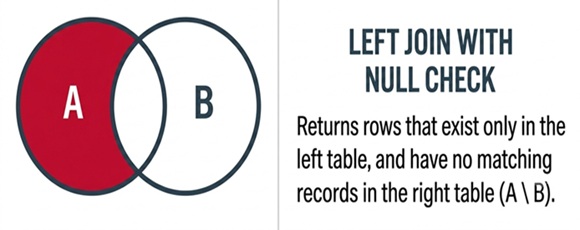
3. LEFT JOIN WITH NULL CHECK
{
    my $rs = $schema->resultset('User')
                    ->search({ 'profile.id' => undef     },
                             { join         => 'profile' });
    is($rs->count, 1,
        "LEFT JOIN NULL CHECK: Returns unique left rows");
}
4. RIGHT JOIN

{
    my $rs = $schema->resultset('Profile')
                    ->search({}, { join => 'user' });
    is($rs->count, 2,
        "RIGHT JOIN: Returns all right records");
}
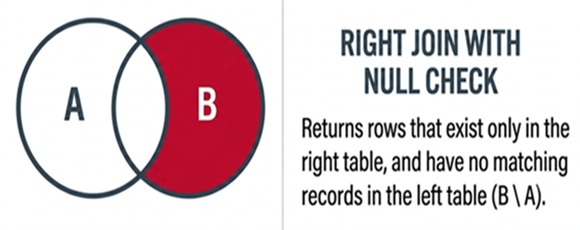
5. RIGHT JOIN WITH NULL CHECK
{
    my $rs = $schema->resultset('Profile')
                    ->search({ 'user.id' => undef  },
                             { join      => 'user' });
    is($rs->count, 1,
        "RIGHT JOIN NULL CHECK: Returns unique right rows");
}
6. FULL OUTER JOIN

DBIx::Class has no native FULL OUTER JOIN support. There is no join_type => 'full' or join_type => 'full outer' option anywhere in DBIx::Class::Relationship or the join/prefetch search attributes.
Only inner and left/left-outer joins are understood by the ORM layer.
This is confirmed directly in the DBIC docs DBIx::Class::SQLMaker::OracleJoins:
Does not support full outer joins (however neither really does DBIC itself).
Some databases e.g. PostgreSQL always, SQLite since 3.39.0, support FULL OUTER JOIN natively at the SQL level, but reaching it would require dropping to literal SQL and bypassing DBIC’s join machinery entirely.
MySQL and older Oracle don’t support it in SQL at all.
{
    my @left_join  = $schema->resultset('User')
                            ->search({},
                                     { prefetch => 'profile' })
                            ->all;

    my @right_only = $schema->resultset('Profile')
                            ->search({ 'user.id' => undef  },
                                     { join      => 'user' })
                            ->all;

    is(scalar(@left_join),  2,
        "FULL OUTER JOIN: LEFT side returns all 2 users");
    is(scalar(@right_only), 1,
        "FULL OUTER JOIN: right-only side returns the 1 orphaned profile");

    my $alice = first { $_->name eq 'Alice' } @left_join;
    my $bob   = first { $_->name eq 'Bob'   } @left_join;

    ok($alice && $alice->profile && $alice->profile->website eq 'alice.dev',
        "FULL OUTER JOIN: Alice's row carries her prefetched profile");
    ok($bob && !defined $bob->profile,
        "FULL OUTER JOIN: Bob's row has an undef profile (true LEFT JOIN, not INNER)");
    is($right_only[0]->id, $orphan_profile->id,
        "FULL OUTER JOIN: right-only row is the orphaned profile, not Alice's");

    my @left_profile_ids = grep { defined }
                           map  { $_->profile ? $_->profile->id : undef }
                           @left_join;

    ok(!(grep { $_ == $orphan_profile->id } @left_profile_ids),
        "FULL OUTER JOIN: orphaned profile is not duplicated on the LEFT side");

    my @full_outer_rows = (@left_join, @right_only);
    is(scalar(@full_outer_rows), 3,
        "FULL OUTER JOIN: Combined set contains exactly 3 distinct rows");
}
Finally done testing.
done_testing;
TESTING
$ prove sql-join.t
sql-join.t .. ok
All tests successful.
Files=1, Tests=12,  0 wallclock secs ( 0.00 usr  0.01 sys +  0.12 cusr  0.05 csys =  0.18 CPU)
Result: PASS
Happy Hacking !!!