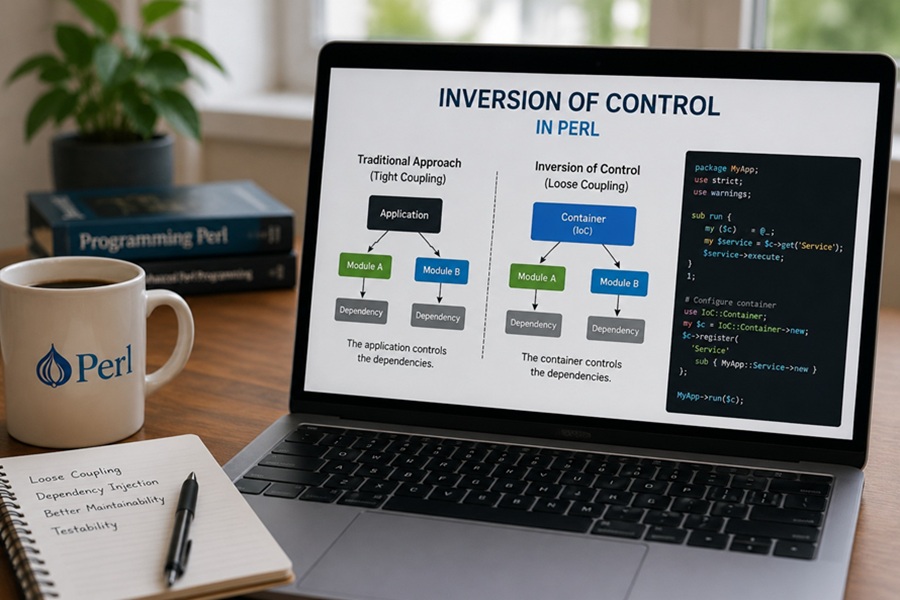
DISCLAIMER: Image is generated using ChatGPT.
Yesterday, I posted a blog, SOLID using Perl where I discussed the SOLID design principles in detail.
While my brain was still in the Design Principles world, I decided to tackle one more topic somewhat related i.e. Inversion of Control (IoC).
IoC is also referred as Dependency Injection.
As I enjoy reading research papers, I came across two very informative papers:
Inversion of Control (IoC) is a design principle where the control flow of a program is inverted.
Instead of your custom code calling a framework or creating its own dependencies, an external entity injects those dependencies into your code.
The Traditional Approach
Here is a simple, classic example in Perl taking the traditional approach.
In this scenario, a Car class is entirely responsible for creating its own Engine. It is tightly coupled to a specific type of engine.
Problem:
If you want to test the Car with a mock engine, or change it to an ElectricEngine, you have to modify the internal code of the Car class.
package GasEngine;

use strict;
use warnings;

sub new {
    my $class = shift;
    return bless {}, $class;
}

sub start {
    return "Vroom! gas engine roaring.";
}

1;
package Car;

use strict;
use warnings;

use GasEngine;

sub new {
    my $class  = shift;
    my $engine = GasEngine->new;
    return bless { engine => $engine }, $class;
}

sub drive {
    my $self = shift;
    return "Starting the car: " . $self->{engine}->start;
}

1;
Final implementation as unit test:
#!/usr/bin/env perl

use strict;
use warnings;

use Car;
use Test::More;

is(Car->new->drive, 'Starting the car: Vroom! gas engine roaring.');

done_testing;
The IoC / Dependency Injection Approach
In the case of the IoC design principle, we invert the control. The Car no more makes the engine, it only asks for an engine in its constructor.
Here are few of the benefits of IoC:
- Decoupling: The
Carclass does not worry about how the engine is created, it only cares that the engine has astart()method. - Testability: It is easy to pass a
"MockEngine"intoCar->new()without making the car work with a real engine. - Extensibility: It is easy to implement a
HybridEngineby making no changes to theCarclass.
Dependency Injection (DI), brings together the strategies mentioned above.
1. The Strategy Pattern
The Strategy pattern gives a way for classes to swap their algorithms at runtime. It makes it necessary that a class does not hardcode its behaviour, but uses an accept an object of the class which implements a certain interface.
2. The Factory Pattern
The Factory pattern aims to conceal the use of the new keyword. The Factory pattern lets a class use the Factory object instead of creating its own dependencies.
3. DI is the Glue
In a traditional setup, you would have to manually write code to call the Factory, get the object, and pass it into the Strategy.
Dependency Injection acts as the automated broker. It says:
I will use the
Factoryto create the object, and then I will automatically inject it into the class using theStrategystructure.
Let’s re-create the example:
package ElectricEngine;

use strict;
use warnings;

sub new {
    my $class = shift;
    return bless {}, $class;
}

sub start {
    return "Silent hum... Electric power ready.";
}

1;
package Car;

use strict;
use warnings;

sub new {
    my ($class, $engine) = @_;
    return bless { engine => $engine }, $class;
}

sub drive {
    my $self = shift;
    return "Starting the car: " . $self->{engine}->start;
}

1;
Implementation of IoC as unit test:
#!/usr/bin/env perl

use strict;
use warnings;

use Test::More;

use Car;
use GasEngine;
use ElectricEngine;

my $gas_engine      = GasEngine->new;
my $gas_car         = Car->new($gas_engine);
my $electric_engine = ElectricEngine->new;
my $electric_car    = Car->new($electric_engine);

is($gas_car->drive, 'Starting the car: Vroom! gas engine roaring.');
is($electric_car->drive, 'Starting the car: Silent hum... Electric power ready.');

done_testing;
It is common for programmers to use CPAN modules such as Bread::Board in large applications written in Perl, as they allow the automation of this injection process. These modules act as sophisticated IoC containers.
Bread::Board works with a structure resembling a tree that declares dependencies (services) of a container (board).
Step 1: The Strategy Pattern
The Strategy pattern dictates that the Car should be completely unaware of the specific type of engine it has. It just expects an object that can roar.
The Strategies
package GasEngine;
sub new  { my $class = shift; return bless {}, $class;  }
sub roar { return "Vroom! gas engine roaring."          }

package ElectricEngine;
sub new  { my $class = shift; return bless {}, $class;  }
sub roar { return "Slient hum... Electric power ready." }
The Context
package Car;
sub new {
    my ($class, %args) = @_;
    return bless { engine => $args{engine} }, $class;
}
sub drive {
    my ($self) = @_;
    return "Car status: " . $self->{engine}->roar;
}
Step 2: The Factory Pattern
If we were doing this manually, we would use a Factory to handle the setup of the engines so the main application code doesn’t have to deal with configuring them.
package EngineFactory;

sub create_engine {
    my ($class, $type) = @_;

    if ($type eq 'gas') {
        return GasEngine->new;
    }
    elsif ($type eq 'electric') {
        return ElectricEngine->new;
    }
    die "Unknown engine type";
}
Step 3: Combining into Dependency Injection
Now we let Bread::Board take the Factory logic i.e. creating the engines and the Strategy setup i.e. injecting the engine into the car and fuse them together automatically.
#!/usr/bin/env perl

use strict;
use warnings;

use Test::More;

use Car;
use GasEngine;
use ElectricEngine;

use Bread::Board;

my $garage = container 'Garage' => as {
    service 'gas_engine' => (
        block => sub { GasEngine->new }
    );

    service 'electric_engine' => (
        block => sub { ElectricEngine->new }
    );

    service 'gas_car' => (
        dependencies => {
            chosen_engine => 'gas_engine',
        },
        block => sub {
            my $s = shift;
            return Car->new( engine => $s->param('chosen_engine') );
        },
    );

    service 'electric_car' => (
        dependencies => {
            chosen_engine => 'electric_engine',
        },
        block => sub {
            my $s = shift;
            return Car->new( engine => $s->param('chosen_engine') );
        },
    );
};

is($garage->resolve( service => 'gas_car' )->drive, "Car status: Vroom! gas engine roaring.");
is($garage->resolve( service => 'electric_car' )->drive, "Car status: Slient hum... Electric power ready.");

done_testing;
The Breakdown
Strategy: The
Carhas been designed to possess changeable engine slots.
Factory: The
gas_engineandelectric_engineservice blocks ensure the constructor ofnew()objects takes place.
DI Container: It solves the dependencies and fetches the created object from the factory block.
Happy Hacking !!!