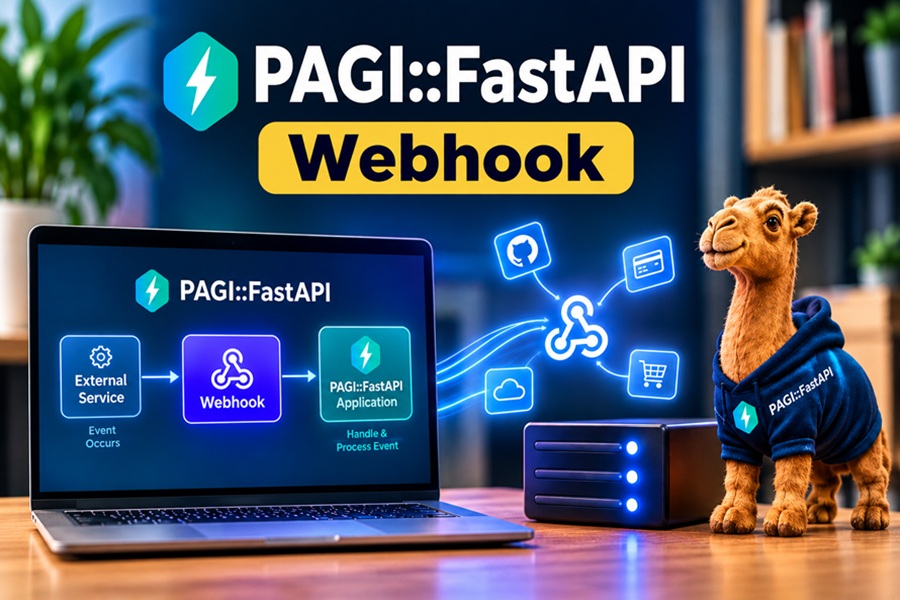
DISCLAIMER: Image is generated using ChatGPT.
So far, I have discussed WebSocket, API Gateway and Message Queue. In this post, I will talk about Webhook.
Webhooks serve as the foundation for contemporary event-driven architectures. Whether it’s the integration of Stripe’s payment alerts, tracking repository push events through GitHub, or synchronising the live user experience, webhooks provide instantaneous communication channels of connected microservices.
Picture a webhook as an automated software alarm system providing "don’t call us, we’ll call you" notifications. Rather than asking a server repeatedly if there is new data (polling), the webhook fires an HTTP POST request with payload data to a URL immediately after an occurrence takes place.
For instance, if a customer buys a t-shirt from an online store, Shopify does not wait for fulfillment software to inquire if there is an order; it sends the webhook immediately with the order information to the warehouse software to commence the packing process.
In this deep dive, we walk through building a complete, lightweight, and production-grade Webhook using Perl’s modern async framework: PAGI::FastAPI.
Architecture Overview
Our demo application covers two fundamental webhook paradigms within a single service:
- Webhook Producer (Dispatcher)
Registers subscriber target endpoints, constructs event payloads, and dispatches them asynchronously over HTTP.
- Webhook Consumer (Receiver)
Receives incoming payloads, enforces security via HMAC SHA-256 signature verification, and processes domain events.
- Real-time Monitoring UI
An interactive single-page dashboard to trigger domain events and view live verification logs.
        [ Web Dashboard UI ]
                |
                ▼ (Trigger Event)
    +------------------------+         HTTP POST w/ Signature          +------------------------+
    |   Webhook Dispatcher   | --------------------------------------> |    Incoming Receiver   |
    |   (/events/trigger)    |    X-PAGI-Signature: 2085a17bdb...      |  (/webhooks/incoming)  |
    +------------------------+                                         +------------------------+
                                                                                   │
                                                                         (Verify HMAC SHA-256)
                                                                                   │
                                                                                   ▼
                                                                         [ Live Feed Dashboard ]
The HMAC Signature Challenge
One of the most important aspects of webhook security is payload signature verification.
When sending a payload, the dispatcher computes a cryptographic signature:
Signature = HMAC-SHA256 (Secret, Payload String)
When the consumer receives the HTTP request, it recomputes the HMAC signature using the shared secret and compares it to the incoming header (X-PAGI-Signature).
The Problem
In Perl (and many dynamic languages), hash key iteration order is non-deterministic. If the dispatcher formats JSON as:
{"data":{"user_id":101},"event_type":"user.signup"}
and the receiver parses it into a HashRef and re-serialises it as:
{"event_type":"user.signup","data":{"user_id":101}}
the calculated HMAC hashes will never match, resulting in an artificial signature failure.
The Solution
To guarantee bit-for-bit equivalence across HTTP boundaries, both the dispatcher and receiver enforce canonical JSON sorting via JSON::PP:
my $json_formatter = JSON::PP->new->canonical(1)->utf8(1);
my $canonical_json = $json_formatter->encode($payload);
By sorting keys alphabetically prior to signature calculation, both sender and receiver evaluate the exact same byte sequence.
Application Code
The complete single-file Perl application: eg/webhook_demo.pl:
The demo app shipped with PAGI::FastAPI v1.2.6.
First the ground work:
use v5.38;
use HTTP::Tiny;
use PAGI::FastAPI;
use Future::AsyncAwait;
use JSON::PP qw(encode_json);
use Digest::SHA qw(hmac_sha256_hex);

my $SHARED_SECRET = 'my_shared_secret';

my $app = PAGI::FastAPI->new(
    title   => 'PAGI::FastAPI Webhook Dashboard',
    version => '1.0.0',
);

# In-memory data stores
my @subscribers;
my @delivery_logs;
The dashboard:
my $html_content = do { local $/; <DATA> };
$app->get('/',
    summary => 'Serve Webhook Management Dashboard',
    handler => async sub ($c) { $c->html($html_content); },
);
The subscribe route:
$app->post('/webhooks/subscribe',
    summary => 'Register a new webhook target endpoint',
    handler => async sub ($c) {
        my $body       = $c->body // {};
        my $target_url = $body->{target_url};
        my $secret     = $body->{secret} // 'default_secret';

        unless ($target_url) {
            $c->status(400);
            return { error => 'Missing target_url in request body' };
        }

        my $sub = {
            id         => scalar(@subscribers) + 1,
            target_url => $target_url,
            secret     => $secret,
            created_at => time(),
        };

        push @subscribers, $sub;

        unshift @delivery_logs, {
            timestamp  => scalar(localtime),
            event      => 'subscriber.created',
            target     => $target_url,
            status     => 200,
            status_msg => "Subscriber Registered (ID: $sub->{id})",
            details    => {
                subscriber_id => $sub->{id},
                target_url    => $target_url,
                secret_key    => '*' x length($secret),
            },
        };

        return {
            status     => 'subscribed',
            subscriber => $sub,
        };
    }
);
The event trigger:
$app->post('/events/trigger',
    summary => 'Simulate a domain event that dispatches webhooks to all subscribers',
    handler => async sub ($c) {
        my $body       = $c->body // {};
        my $event_type = $body->{event_type};

        my $payload = {
            event_id   => 'evt_' . time(),
            event_type => $event_type,
            timestamp  => time(),
            data       => {
                user_id => 101,
                message => "Action $event_type successfully processed",
            },
        };

        my $json_formatter = JSON::PP->new->canonical(1)->utf8(1);
        my $json_payload   = $json_formatter->encode($payload);
        my $dispatched_count = 0;
        my $ua = HTTP::Tiny->new(timeout => 5);

        for my $sub (@subscribers) {
            my $signature = hmac_sha256_hex($json_payload, $sub->{secret});

            my $res = $ua->post($sub->{target_url}, {
                headers => {
                    'Content-Type'     => 'application/json',
                    'X-PAGI-Signature' => $signature,
                    'X-PAGI-Event'     => $event_type,
                },
                content => $json_payload,
            });

            if ($res->{success}) {
                $dispatched_count++;
            }
        }

        return {
            status     => 'dispatched',
            event      => $payload,
            delivered  => $dispatched_count,
            total_subs => scalar(@subscribers),
        };
    }
);
The webhook incoming:
$app->post('/webhooks/incoming',
    summary => 'Endpoint that receives, verifies, and consumes incoming webhooks',
    handler => async sub ($c) {
        my $data      = $c->body // {};
        my $event     = $c->header('x-pagi-event')     // $c->header('X-PAGI-Event')     // 'unknown';
        my $signature = $c->header('x-pagi-signature') // $c->header('X-PAGI-Signature') // '';

        my $json_formatter = JSON::PP->new->canonical(1)->utf8(1);
        my $raw_body       = $json_formatter->encode($data);

        my $matched = 0;
        my $expected_sig = '';

        my @secrets = map { $_->{secret} } @subscribers;
        push @secrets, $SHARED_SECRET unless @secrets;

        for my $sec (@secrets) {
            my $candidate_sig = hmac_sha256_hex($raw_body, $sec);
            if (constant_time_eq($signature, $candidate_sig)) {
                $matched = 1;
                $expected_sig = $candidate_sig;
            }
        }

        my $status_code = $matched ? 200 : 401;
        my $status_msg  = $matched ? 'Verified & Accepted' : 'Signature Verification Failed';

        unless ($matched) {
            $c->status(401);
        }

        unshift @delivery_logs, {
            timestamp  => scalar(localtime),
            event      => $event,
            target     => '/webhooks/incoming',
            status     => $status_code,
            status_msg => $status_msg,
            details    => { payload => $data },
        };

        return { status => $status_msg, event => $event };
    }
);
And finally the logs:
$app->get('/webhooks/logs',
    summary => 'Retrieve current delivery logs',
    handler => async sub ($c) {
        return \@delivery_logs;
    }
);
Demo Action
Start the pagi-server server
$ pagi-server eg/webhook_demo.pl
Open the Web UI
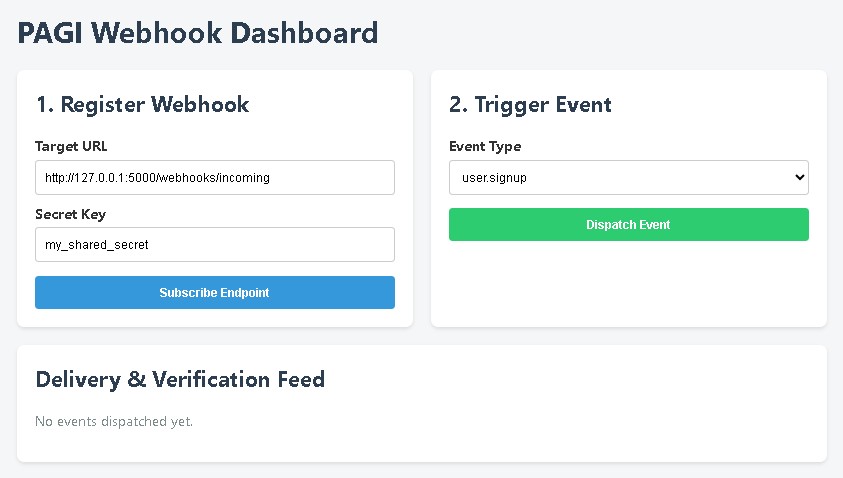
Navigate to http://127.0.0.1:5000 in your web browser.
Register an Endpoint
Keep the default values and click Subscribe Endpoint.
You should see this in the log section:
[Sun Aug 23 11:45:34 2026] Event: subscriber.created (Subscriber Registered (ID: 1))
Target: http://127.0.0.1:5000/webhooks/incoming
{
    "secret_key": "****************",
    "subscriber_id": 1,
    "target_url": "http://127.0.0.1:5000/webhooks/incoming"
}
Trigger Events:
Select an event type (e.g., user.signup, order.created, payment.completed) and click Dispatch Event.
You will instantly see verification logs appear in the feed confirming that the HMAC signature was computed, transmitted, and validated successfully!
On user.signup event trigger, we got this:
[Sun Aug 23 11:48:25 2026] Event: user.signup (Verified & Accepted)
Target: /webhooks/incoming
{
    "payload": {
        "data": {
            "message": "Action user.signup successfully processed",
            "user_id": 101
        },
        "event_id": "evt_1787482100",
        "event_type": "user.signup",
        "timestamp": 1787482100
    }
}
On order.created event trigger, we have this:
[Sun Aug 23 11:51:40 2026] Event: order.created (Verified & Accepted)
Target: /webhooks/incoming
{
    "payload": {
        "data": {
            "message": "Action order.created successfully processed",
            "user_id": 101
        },
        "event_id": "evt_1787482295",
        "event_type": "order.created",
        "timestamp": 1787482295
    }
}
amd finally on payment.completed event, we got this:
[Sun Aug 23 11:53:09 2026] Event: payment.completed (Verified & Accepted)
Target: /webhooks/incoming
{
    "payload": {
        "data": {
            "message": "Action payment.completed successfully processed",
            "user_id": 101
        },
        "event_id": "evt_1787482384",
        "event_type": "payment.completed",
        "timestamp": 1787482384
    }
}
Key Takeaways
- PAGI::FastAPI makes writing modern, asynchronous Perl APIs intuitive and structured.
- Security First: Never trust unauthenticated webhooks, always require
HMAC SHA-256signature headers. - Canonical JSON is Critical: Always serialise
JSONdeterministically when performing cryptographic signature checks.
Happy Hacking !!!