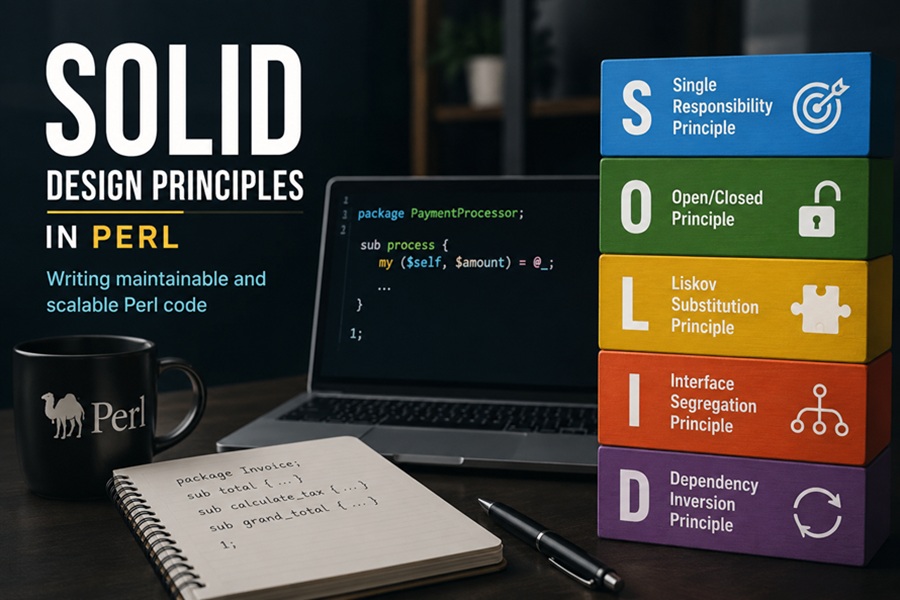
DISCLAIMER: Image is generated using ChatGPT.
When I was working on my first book, Design Patterns in Modern Perl, I touched the topic, SOLID, little bit.
Now I realise, it should have been given a dedicated chapter on its own.
Never mind, I can talk about it now in this blog post.
Design Patterns sounds very similar to Design Principles but they both operate at completely different levels of abstraction.
Take an example of building a house: Principles are the building codes while Patterns are the architectural solutions.
Perl is famous for its philosophy:
There’s More Than One Way To Do It (TMTOWTDI).
While this freedom is incredibly empowering, it can also lead to write-only spaghetti code if we aren’t careful.
Here is the breakdown of Design Principles:
[S]ingle Responsibility Principle (SRP)[O]pen/Closed Principle (OCP)[L]iskov Substitution Principle (LSP)[I]nterface Segregation Principle (ISP)[D]ependency Inversion Principle (DIP)
Applying the SOLID design principles in Perl gives us the structural protection needed to keep our code clean, testable, and highly maintainable, even in a highly dynamic, loosely-typed environment.
[S]ingle Responsibility Principle
A class should have one, and only one, reason to change.
In Perl, it is incredibly easy to write "God classes" that fetch data, process it, format it, and print it all in one package.
SRP tells us to break these tasks into separate, dedicated modules.
The Violation
Here, the Order class is doing too much: it manages order data and handles the formatting and printing.
If the printing format changes, we have to modify the core business logic class.
package Order;

use strict;
use warnings;

sub new {
    my ($class, %args) = @_;
    return bless \%args, $class;
}

sub get_items { shift->{items} }

sub calculate_total {
    my $self  = shift;
    my $total = 0;
    $total += $_->{price} for @{ $self->{items} };
    return $total;
}

# VIOLATION: Formatting/Printing responsibility
sub print_invoice {
    my $self = shift;
    print "--- INVOICE ---\n";
    print "Total: \$" . $self->calculate_total() . "\n";
}

1;
The Solution
We split the responsibilities. Order handles the business logic, while InvoicePrinter handles how it gets displayed.
package Order;

use strict;
use warnings;

sub new {
    my ($class, %args) = @_;
    return bless \%args, $class;
}

sub get_items { shift->{items} }

sub calculate_total {
    my $self  = shift;
    my $total = 0;
    $total += $_->{price} for @{ $self->{items} };
    return $total;
}

1;
package InvoicePrinter;

use strict;
use warnings;

sub print_text {
    my ($self, $order) = @_;
    print "--- INVOICE ---\n";
    print "Total: \$" . $order->calculate_total() . "\n";
}

1;
[O]pen/Closed Principle (OCP)
Software entities should be open for extension, but closed for modification.
You should be able to add new features or behaviours without modifying the existing codebase.
In Perl, we achieve this through polymorphism instead of hardcoding complex if-else statements checking object types.
The Violation
If we want to support a new shape (e.g., a Triangle), we are forced to modify the AreaCalculator class to add another elsif block.
package Rectangle;

use strict;
use warnings;

sub new {
    my ($class, $w, $h) = @_;
    return bless { w => $w, h => $h }, $class;
}

1;
package Circle;

use strict;
use warnings;

sub new {
    my ($class, $r) = @_;
    return bless { r => $r }, $class;
}

1;
package AreaCalculator;

use strict;
use warnings;

sub calculate {
    my ($self, $shapes) = @_;
    my $total_area = 0;

    for my $shape (@$shapes) {
        if ($shape->isa('Rectangle')) {
            $total_area += $shape->{w} * $shape->{h};
        } elsif ($shape->isa('Circle')) {
            $total_area += 3.14159 * ($shape->{r} ** 2);
        }
    }
    return $total_area;
}

1;
The Solution
We close AreaCalculator to modification by shifting the responsibility of calculating the area to the shapes themselves.
Now, we can add infinitely many new shapes without touching AreaCalculator.
package Rectangle;

use strict;
use warnings;

sub new {
    my ($class, $w, $h) = @_;
    return bless { w => $w, h => $h }, $class;
}

sub area {
    my $self = shift;
    return $self->{w} * $self->{h};
}

1;
package Circle;

use strict;
use warnings;

sub new {
    my ($class, $r) = @_;
    return bless { r => $r }, $class;
}

sub area {
    my $self = shift;
    return 3.14159 * ($self->{r} ** 2);
}

1;
package AreaCalculator;

use strict;
use warnings;

sub calculate {
    my ($self, $shapes) = @_;
    my $total_area = 0;

    for my $shape (@$shapes) {
        $total_area += $shape->area();
    }
    return $total_area;
}
1;
[L]iskov Substitution Principle (LSP)
Subtypes must be substitutable for their base types without altering the correctness of the program.
If class B is a subclass of class A, we should be able to pass an instance of B to any code expecting A without breaking it.
In geometry, we are taught that "a square is just a special type of rectangle".
Naturally, a developer might try to model this relationship in code using inheritance, Square inherits from Rectangle.
A classic example of an LSP violation is the Square inheriting from a Rectangle.
The Violation
Since a Square must have equal width and height, forcing it to inherit from Rectangle breaks expectations.
A user of a Rectangle expects that changing the width leaves the height untouched.
package Rectangle;

use strict;
use warnings;

sub new {
    my ($class, $w, $h) = @_;
    return bless { w => $w, h => $h }, $class;
}

sub set_width {
    my ($self, $w) = @_;
    $self->{w} = $w;
}

sub set_height {
    my ($self, $h) = @_;
    $self->{h} = $h;
}

sub area {
    my $self = shift;
    return $self->{w} * $self->{h};
}

1;
package Square;

use strict;
use warnings;

use parent qw/Rectangle/;

# VIOLATION: To keep it square, setting width changes height too.
sub set_width {
    my ($self, $w) = @_;
    $self->{w} = $w;
    $self->{h} = $w;
}

sub set_height {
    my ($self, $h) = @_;
    $self->{w} = $h;
    $self->{h} = $h;
}

1;
Why this breaks substitution?
The core rule of the Liskov Substitution Principle is
You must be able to swap out a parent class with a child class without the program behaving unexpectedly or breaking.
The implicit contract of a Rectangle class is:
1. Setting the width only changes the width.
2. Setting the height only changes the height.
By modifying the height when the width is set, Square breaks that promise.
Even though a square is geometrically a rectangle, behaviourally, it is not.
A test function expects a Rectangle but would fail if we pass a Square.
sub test_rect {
    my $rect = shift;
    $rect->set_width(10);
    $rect->set_height(5);
    die "LSP Broken!" unless $rect->area() == 50;
}
The Solution
Instead of forcing an incorrect inheritance model, both classes should implement a common interface.
package Rectangle;

use strict;
use warnings;

sub new {
    my ($class, $w, $h) = @_;
    return bless { w => $w, h => $h }, $class;
}

sub area {
    my $self = shift;
    return $self->{w} * $self->{h};
}

1;
package Square;

use strict;
use warnigns;

sub new {
    my ($class, $size) = @_;
    return bless { size => $size }, $class;
}

sub area {
    my $self = shift;
    return $self->{size} ** 2;
}

1;
[I]nterface Segregation Principle (ISP)
Clients should not be forced to depend on methods they do not use.
Perl doesn’t have native, compiler-enforced interfaces.
However, ISP is highly relevant to Perl when we design object roles.
A massive package that forces child classes/consumers to implement unnecessary methods violates ISP.
The Violation
If we define a master "Worker" interface, a robotic worker is forced to implement a useless eat method.
package WorkerInterface;

use strict;
use warnings;

sub work { die "Must implement work" }
sub eat  { die "Must implement eat"  }

1;
package Robot;

use strict;
use warnings;

use parent qw/WorkerInterface/;

sub work { print "Robot is building cars.\n" }

# VIOLATION: Forced to implement an unused method
sub eat  { die "Error: Robots do not eat!"   }

1;
The Solution
Instead of a single bloated interface, we segregate behaviors into small, focused modules or roles.
package Workable;

use strict;
use warnings;

sub work { die "Must implement work" }

1;
package Feedable;

use strict;
use warnings;

sub eat { die "Must implement eat" }

1;
A Human implements both, Workable and Feedable:
package HumanWorker;

use strict;
use warnings;

use parent qw/Workable Feedable/;

sub work { print "Human working...\n" }
sub eat  { print "Human eating...\n"  }

1;
A Robot only implements Workable:
package RobotWorker;

use strict;
use warnings;

use parent qw/Workable/;

sub work { print "Robot working...\n" }

1;
[D]ependency Inversion Principle (DIP)
High-level modules should not depend on low-level modules. Both should depend on abstractions.
If your high-level business logic class directly instantiates a specific database connection or API client, they are tightly coupled.
DIP decouples them by "injecting" the dependency.
The Violation
The UserManager is tightly bound to MySQLDatabase.
If you want to switch to SQLite or mock the database for testing, you have to modify UserManager.
package MySQLDatabase;

use strict;
use warnings;

sub new   { bless {}, shift }
sub query { my ($self, $sql) = @_; return "Results for $sql" }

1;
package UserManager;

use strict;
use warnings;

sub new {
    my $class = shift;
    # VIOLATION: Direct dependency on a low-level concrete class
    my $db = MySQLDatabase->new();
    return bless { db => $db }, $class;
}

sub get_user {
    my ($self, $id) = @_;
    return $self->{db}->query("SELECT * FROM users WHERE id = $id");
}

1;
The Solution
We inject the database client into the constructor.
UserManager now doesn’t care what database is used, as long as it responds to the query method.
package UserManager;

use strict;
use warnings;

sub new {
    my ($class, $db_connection) = @_;
    return bless { db => $db_connection }, $class;
}

sub get_user {
    my ($self, $id) = @_;
    return $self->{db}->query("SELECT * FROM users WHERE id = $id");
}

1;
Works with MySQL
my $mysql_db = MySQLDatabase->new();
my $manager  = UserManager->new($mysql_db);
Works just as easily with a mock database during testing.
package MockDatabase;
sub new   { bless {}, shift         }
sub query { return "Mock user data" }

package main;
my $mock_db      = MockDatabase->new();
my $test_manager = UserManager->new($mock_db);
Happy Hacking !!!