DISCLAIMER: Image is generated using ChatGPT.
I am giving an online presentation on PAGI::FastAPI organised by Gabor Szabo. It is happening on 7th September 2026 18:30 BST. If you are interested then you can register to the online event: Async, Type-Safe, and Secure: Perl’s Answer to FastAPI.
I created the draft presentation slides as soon as the event was booked. But with every release of PAGI::FastAPI, I had to update the presentation slides. This is the final features update as far as Python’s FastAPI features. The missing features added in this release: File Uploads, Background Tasks and Per-route OpenAPI Metadata.
I won’t go into technical details in this post, instead I will talk about the demo applications that show the power of new features added.
File Uploads
Source: eg/file_uploads_demo.pl
Single file upload using $c->form_data and $c->uploaded_file.
$app->post('/profile/avatar',
    tags        => ['Uploads'],
    summary     => 'Upload a profile avatar',
    description => 'Accepts a multipart/form-data body with a "caption" '
                 . 'text field and an "avatar" file part.',
    responses   => {
        422 => { description => 'No avatar file was provided' },
    },
    handler => async sub ($c) {
        my $caption = $c->form_data('caption') // '';
        my $avatar  = $c->uploaded_file('avatar');

        unless ($avatar) {
            $c->status(422);
            return { detail => "Missing 'avatar' file" };
        }

        return {
            caption      => $caption,
            filename     => $avatar->{filename},
            content_type => $avatar->{content_type},
            size         => $avatar->{size},
        };
    }
);
Multiple files under one field name using $c->uploaded_files.
$app->post('/gallery',
    tags        => ['Uploads'],
    summary     => 'Upload several photos at once',
    description => 'Accepts a multipart/form-data body with one or more '
                  . '"photos" file parts sharing the same field name.',
    handler => async sub ($c) {
        my $photos = $c->uploaded_files('photos');
        return {
            count     => scalar(@$photos),
            filenames => [ map { $_->{filename} } @$photos ],
        };
    }
);
Start the app like below:
$ pagi-server eg/file_uploads_demo.pl
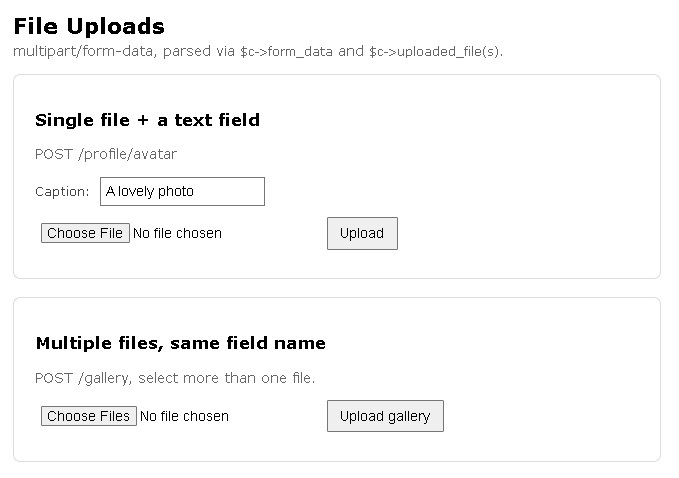
The landing page of the demo looks like this: http://localhost:5000
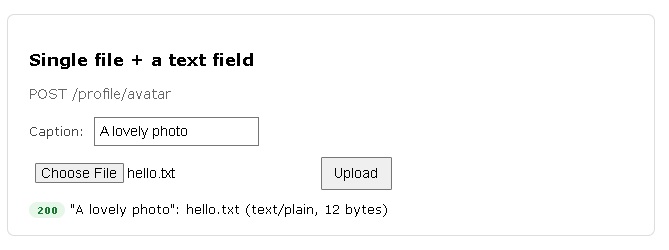
Now, uploading the single file:
Final multiple file uploads:
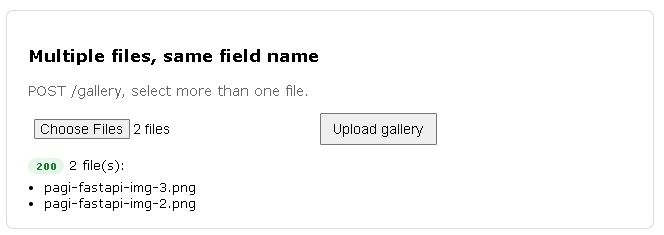
During the demo, I found a bug in multiple file uploads. It was only picking one file when I upload two files.
I had to release a quick fix PAGI::FastAPI v1.7.1.
Background Tasks
Source: eg/background_demo.pl
Signup route to initiate the background task:
$app->post('/signup',
    tags        => ['Onboarding'],
    summary     => 'Create an account',
    description => 'Responds immediately; the welcome email is sent '
                  . 'afterward via a background task and shows up in '
                  . 'GET /activity-log once it completes.',
    body        => { email => Str },
    responses   => {
        202 => { description => 'Account created, welcome email queued' },
    },
    handler => async sub ($c) {
        my $email = $c->body('email');
        my $entry = { email => $email, status => 'queued' };
        push @activity_log, $entry;

        $c->background(async sub {
            # Simulated slow work (an SMTP call, a templating step, ...).
            # A real handler would await that call directly instead of
            # $c->sleep, this is here purely so the demo's "queued" ->
            # "done" transition is visible for a couple of seconds.
            await $c->sleep(2);
            $entry->{status} = 'done';
        });

        $c->status(202);
        return { status => 'queued', email => $email };
    }
);
Activity log tracker.
$app->get('/activity-log',
    tags        => ['Onboarding'],
    summary     => 'List queued/completed welcome emails',
    description => 'Demo-only introspection endpoint backed by an '
                  . 'in-memory array, so the dashboard can show a '
                  . 'background task finishing after its request '
                  . 'already returned.',
    handler => async sub ($c) {
        return { entries => \@activity_log };
    }
);
Start the app like below:
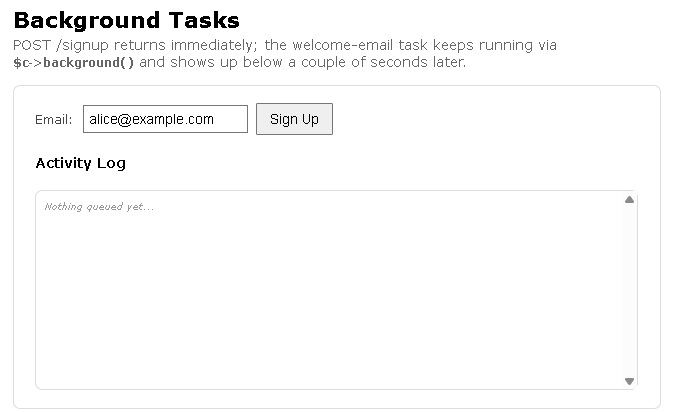
$ pagi-server eg/background_demo.pl
The landing page of the demo looks like this: http://localhost:5000
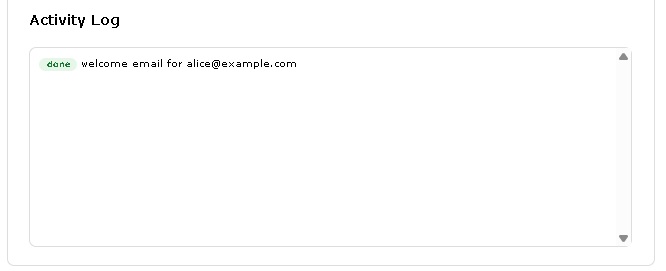
Few seconds later, we see the update:
Per-route OpenAPI Metadata
Source: eg/docs_demo.pl
GET /widgets route that returns all stored widget values formatted as a JSON object.
It includes OpenAPI metadata (tags, summary, and custom responses) that populates interactive Swagger UI docs.
Additionally, it attaches OpenAPI links to the 200 and 422 responses.
$app->get('/widgets',
    tags      => ['Widgets'],
    summary   => 'List all widgets',
    responses => {
        200 => {
            description => 'The current widgets',
            links       => {
                CreateWidget => {
                    operationId => OP_CREATE_WIDGET,
                    description => 'Create a new widget',
                },
            },
        },
        422 => {
            description => 'Invalid query parameters',
            links       => {
                CreateWidget => {
                    operationId => OP_CREATE_WIDGET,
                    description => 'Create a new widget instead',
                },
            },
        },
    },
    handler => async sub ($c) {
        return { widgets => [ values %widgets ] };
    }
);
GET /widgets/{id} endpoint that looks up a widget in %widgets by its URL parameter, returning the object or a 404 JSON payload if missing.
It documents 200, 404, and 422 responses for OpenAPI UI generation.
$app->get('/widgets/{id}',
    tags        => ['Widgets'],
    summary     => 'Fetch one widget',
    description => 'Returns a single widget by its numeric ID.',
    responses   => {
        200 => {
            description => 'The requested widget',
            links       => {
                ArchiveWidget => {
                    operationId => OP_ARCHIVE_WIDGET,
                    parameters  => { id => '$response.body#/id' },
                    description => 'Archive (delete) this widget',
                },
                ListWidgets => {
                    operationId => OP_LIST_WIDGETS,
                    description => 'Back to the full widget list',
                },
            },
        },
        404 => {
            description => 'No widget with that ID',
            links       => {
                ListWidgets => {
                    operationId => OP_LIST_WIDGETS,
                    description => 'Browse existing widgets instead',
                },
                CreateWidget => {
                    operationId => OP_CREATE_WIDGET,
                    description => 'Or create one with this ID in mind',
                },
            },
        },
        422 => {
            description => 'The ID was not a valid widget ID',
            links       => {
                ListWidgets => {
                    operationId => OP_LIST_WIDGETS,
                    description => 'See a list of valid IDs',
                },
            },
        },
    },
    handler => async sub ($c) {
        my $widget = $widgets{ $c->param('id') };
        unless ($widget) {
            $c->status(404);
            return { detail => 'Widget not found' };
        }
        return $widget;
    }
);
POST /widgets endpoint to create a widget, returning 201 Created with the new widget data or 409 Conflict if the name is duplicated.
It explicitly overrides the framework’s default 200 response metadata in favour of 201, 409, and 422 definitions.
$app->post('/widgets',
    tags        => ['Widgets'],
    summary     => 'Create a widget',
    description => 'Creates a new widget and returns its ID.',
    body        => { name => Str },
    responses   => {
        # Every route keeps the framework's default 200 entry unless it's
        # explicitly overridden, even one like this that never actually
        # returns a plain 200 (success here is 201). Overriding it for
        # accuracy, same as everything else in this file getting a links
        # entry instead of "No links".
        200 => {
            description => 'Not actually returned by this operation '.
                           '(success is 201); documented here only because '.
                           'every route keeps a default 200 entry unless '.
                           'overridden',
            links       => {
                ListWidgets => {
                    operationId => OP_LIST_WIDGETS,
                    description => 'See existing widgets',
                },
            },
        },
        201 => {
            description => 'Widget created',
            links       => {
                GetCreatedWidget => {
                    operationId => OP_GET_WIDGET,
                    parameters  => { id => '$response.body#/id' },
                    description => 'Fetch the widget just created',
                },
                ArchiveWidget => {
                    operationId => OP_ARCHIVE_WIDGET,
                    parameters  => { id => '$response.body#/id' },
                    description => 'Changed your mind? Archive it again',
                },
            },
        },
        409 => {
            description => 'A widget with that name already exists',
            links       => {
                ListWidgets => {
                    operationId => OP_LIST_WIDGETS,
                    description => 'See what already exists under that name',
                },
            },
        },
        422 => {
            description => 'Missing or invalid "name" field',
            links       => {
                ListWidgets => {
                    operationId => OP_LIST_WIDGETS,
                    description => 'See a valid example',
                },
            },
        },
    },
    handler => async sub ($c) {
        my $name = $c->body('name');

        if (grep { $_->{name} eq $name } values %widgets) {
            $c->status(409);
            return { detail => "A widget named '$name' already exists" };
        }

        my $id = $next_id++;
        $widgets{$id} = { id => $id, name => $name };

        $c->status(201);
        return $widgets{$id};
    }
);
Start the app like below:
$ pagi-server eg/docs_demo.pl
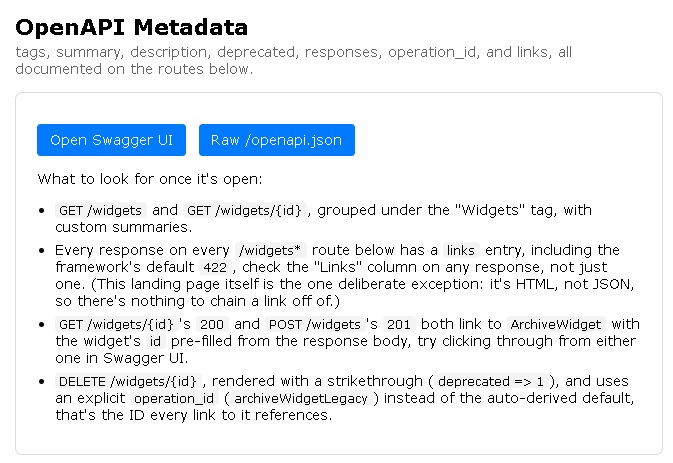
The landing page of the demo looks like this: http://localhost:5000
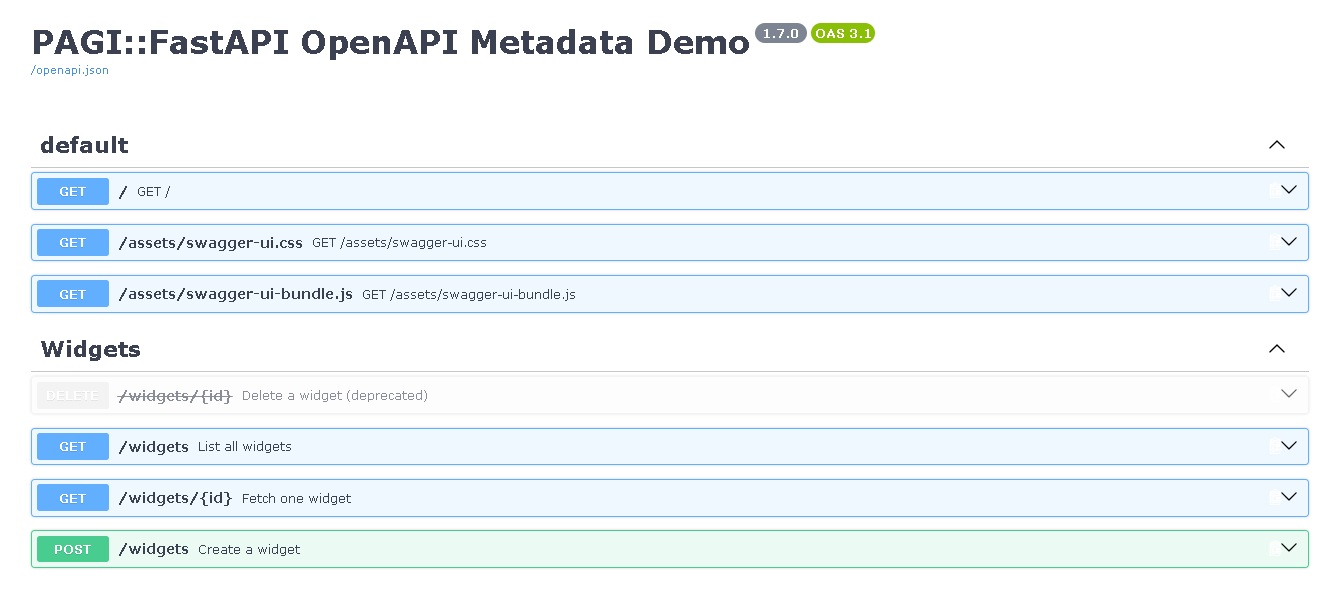
Clicking the button Open Swagger UI, gives this page:
Happy Hacking !!!